
Stock Option Taxes: Tax Planning for ISOs vs. NSOs
If you work at a private company, stock options are likely one of the most valuable parts of your compensation. They are also one of the most tax-complex.
Unlike RSUs, which create a straightforward tax event at vesting, stock options give you a choice: when to exercise, how much to exercise, and how to time that decision relative to your broader financial picture. That flexibility is an advantage, but it also means the tax outcomes vary significantly depending on the decisions you make, and when you make them.
This post is a guide to understanding stock option taxes, including how Incentive Stock Options (ISOs) and Non-Qualified Stock Options (NSOs) are taxed, the key planning considerations for each, and how to approach exercise decisions to minimize unnecessary tax costs.
The Difference Between ISOs and NSOs
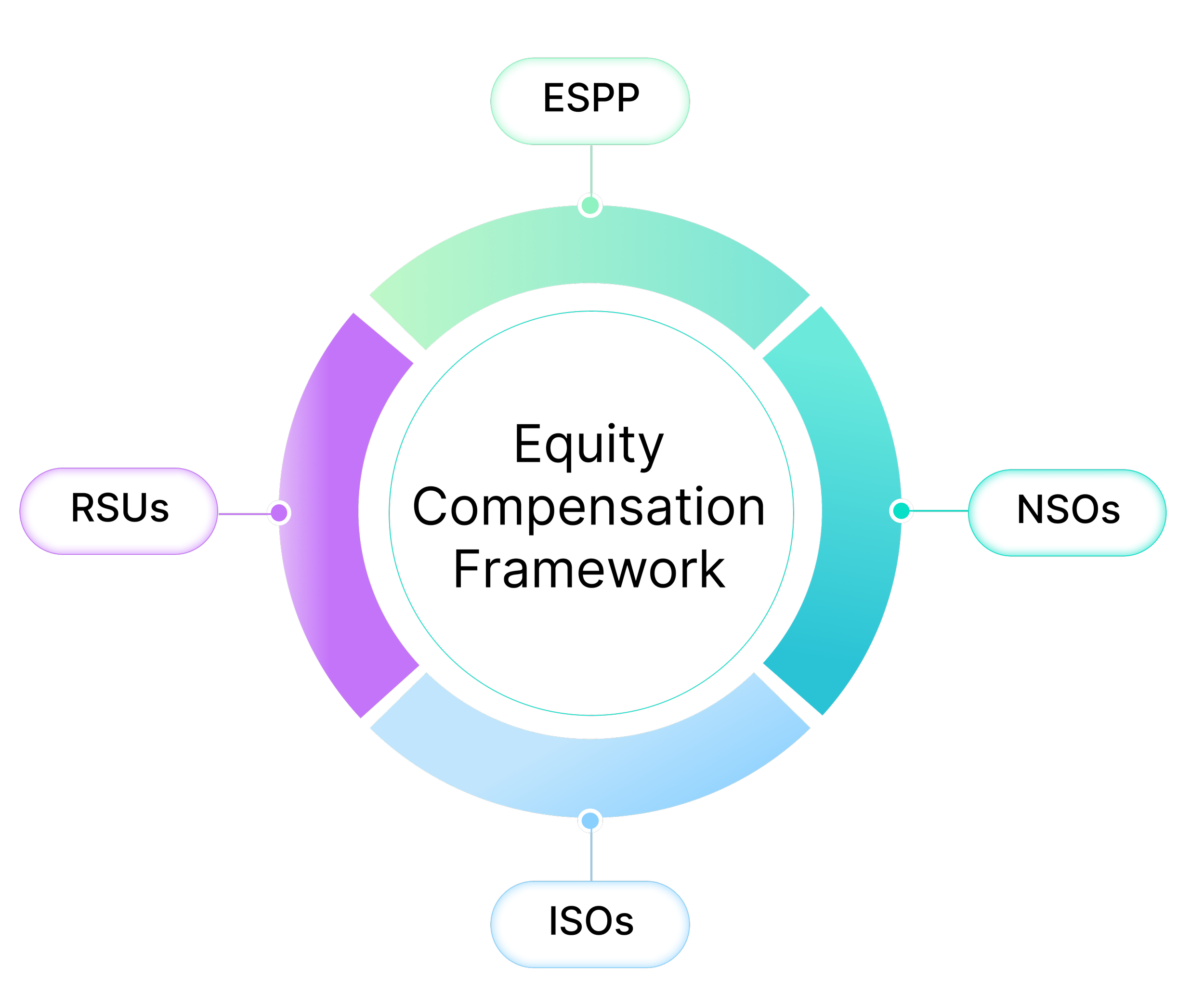
Before getting into stock option tax treatment, it helps to understand the basic distinction. Both ISOs and NSOs give you the right to purchase shares at a set price, called the strike price or exercise price, regardless of what the shares are worth at the time you exercise. The biggest difference lies in how stock option taxes are calculated for each type of option.
ISOs receive preferential tax treatment under the tax code, but come with specific requirements and the risk of triggering the Alternative Minimum Tax (AMT). NSOs are simpler in structure but taxed as ordinary income at exercise, which for high earners can be a significant cost.
Many employees at private companies receive a mix of both.
How ISOs Are Taxed
ISOs are not taxed at grant. They are also not taxed at exercise for regular federal income tax purposes. That is the preferential treatment.
However, the spread between the 409A fair market value and your strike price at the time of exercise is included as a preference item for the Alternative Minimum Tax. This is where ISO planning gets complicated.
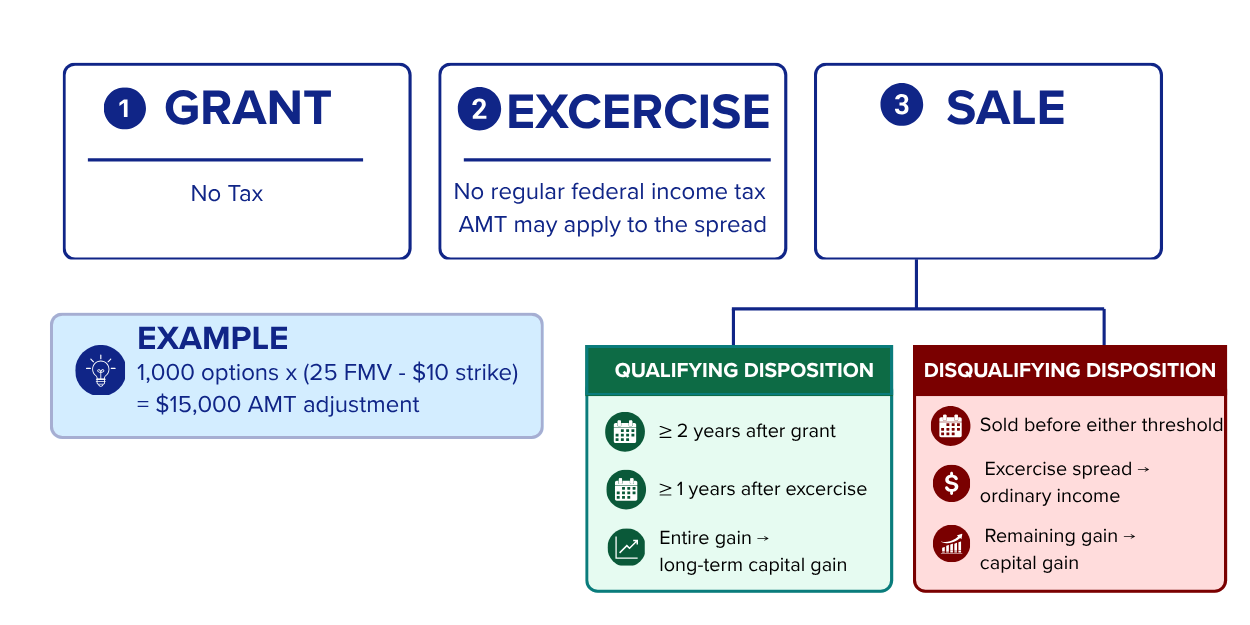
Example: You exercise 1,000 ISOs with a strike price of $10 when the 409A valuation is $25. The $15,000 spread is not taxable for regular income tax purposes, but it is added to your AMT income. Depending on your overall income picture, this may or may not trigger an actual AMT liability.
After exercise, your cost basis is the strike price ($10 per share), and the holding period begins. What happens at the sale depends on whether you meet the qualifying disposition requirements.
Qualifying disposition: You hold the shares for at least two years from the grant date and at least one year from the exercise date. If both conditions are met, the entire gain from strike price to sale price is taxed as long-term capital gains. No ordinary income is recognized.
Disqualifying disposition: You sell before meeting those thresholds. The spread at exercise is taxed as ordinary income, and any additional gain above the 409A value at exercise is taxed as short-term or long-term capital gains, depending on how long you held the shares after exercise.
The qualifying disposition path is meaningfully more tax-efficient for high earners. The difference between ordinary income rates and long-term capital gains rates can be substantial, particularly when state taxes are factored in.
The AMT Problem With ISOs
The Alternative Minimum Tax (AMT) is the most significant and most frequently misunderstood tax risk for employees with ISOs.
The AMT is a parallel tax system with its own rates and its own definition of income. When you exercise ISOs, the spread is added to your AMT income even though it does not appear as regular taxable income. If your AMT liability exceeds your regular tax liability, you owe the difference.
The risk specific to private company employees is that you may owe AMT on shares you cannot yet sell. You exercised, you recognize the spread for AMT purposes, and the tax bill is real, but the shares are illiquid. There are no sale proceeds to fund the payment.
Example: You exercise ISOs with a $500,000 spread in a year when your regular tax bill is $80,000. Your AMT liability comes out to $130,000. You owe $50,000 more than your regular tax, on shares you cannot sell.
A few planning considerations specific to AMT:
The AMT exemption. There is an annual AMT exemption that phases out at higher income levels. Whether a given exercise triggers actual AMT depends on how large the spread is, what your other income looks like, and whether you have other AMT preference items. This calculation needs to be modeled before you exercise, not after.
The AMT credit. When you trigger AMT in one year, you generally receive a credit that can be applied against regular tax in future years when your regular tax exceeds your AMT. This credit can be valuable, but it requires future years with higher regular tax liability to use it, which can result in a multi-year wait to use the tax credit, especially if you are still actively exercising ISO options.
Spreading exercises across years. One of the most effective AMT management tools is simply exercising in pieces across multiple tax years rather than all at once. This keeps the annual spread smaller and may keep you below the AMT threshold entirely in any given year.
Selling in the calendar year of exercise. If you sell ISO shares in the same calendar year you exercise them, the transaction becomes a disqualifying disposition, but it also eliminates the AMT preference item for that year. In some situations, particularly when the AMT liability would be large and the shares are liquid, this tradeoff can be worth it.
How NSOs Are Taxed
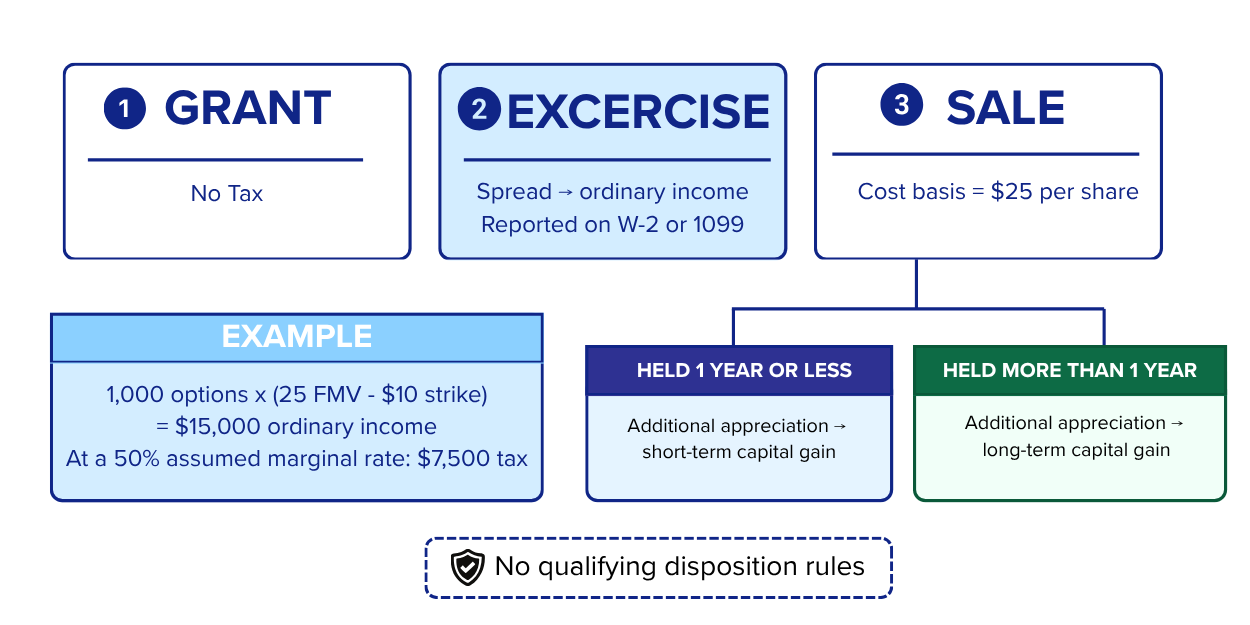
NSOs are simpler. When you exercise an NSO, the spread between the 409A fair market value and the strike price is recognized as ordinary income in the year of exercise. If you are still employed by the company, this appears on your W-2. If you have already left, it is reported on a 1099.
Example: You exercise 1,000 NSOs with a strike price of $10 when the 409A valuation is $25. You recognize $15,000 of ordinary income. At a combined Federal and California marginal rate of 50%, that is a $7,500 tax bill, payable whether or not the shares are liquid.
After exercise, your cost basis is $25 per share, the 409A value at exercise. The holding period begins at exercise. Shares held for more than one year after exercise qualify for long-term capital gains treatment on any subsequent appreciation above that cost basis.
NSOs do not have a qualifying disposition concept. There is no preferential treatment at sale. The only tax planning opportunity on the back end is managing the holding period to qualify for long-term capital gains on appreciation above your exercise cost basis.
The Shared Challenge: Stock Option Taxes Before Liquidity
Both ISOs and NSOs share a planning challenge that is unique to private company employees: taxes can be due before you have any ability to sell.
With NSOs, ordinary income is recognized at exercise. With ISOs, AMT can be triggered at exercise. In both cases, if the shares are illiquid, you are writing a check to the IRS funded from other sources.
This is why exercise timing at a private company is not just an investment decision. It is a liquidity decision and a tax decision simultaneously. Exercising too much too early can result in a tax bill on value that has not yet been realized in cash, and in a worst-case scenario, on value that may never be realized at all.
The practical implication: before exercising options at a private company, model the full tax cost of that exercise, not just the potential upside. If the tax bill would require drawing down savings or taking on debt, scale back until the math is more manageable.
State Taxes
Federal rates are only part of the picture. Many employees at private companies with stock options live and work in California, where the top marginal state income tax rate is 13.3% (the 12.3% top bracket plus the 1% Mental Health Services Tax on income over $1 million).
For NSO exercises, the spread is subject to California ordinary income tax in the year of exercise, the same as the federal treatment. For ISOs, the exercise itself is not a taxable event for regular income tax purposes at the state level, just as it isn't federally. However, California has its own AMT system, and the ISO exercise spread is a preference item for California AMT purposes as well, similar to the federal treatment.
Where ISOs actually lose ground in California is at disposition. California does not offer a preferential rate for long-term capital gains, so all income, including the gain from a qualifying disposition, is taxed under the same rate schedule as ordinary income. This means that even though a qualifying disposition preserves the federal benefit of long-term capital gains treatment, that benefit does not carry over at the state level. ISOs provide less of a relative advantage over NSOs in California than they do federally.
This is a material planning consideration when comparing ISO and NSO strategies for California residents, and it generally means the federal tax picture should drive exercise strategy more than the California-specific mechanics.
For employees who are considering relocating, state tax allocation rules add additional complexity. California allocates stock option income based on the portion of the vesting period during which you were a California resident. Moving before options vest does not necessarily eliminate California's claim on that income. The allocation method can vary depending on the grant type, and multi-state filings for option income are genuinely complex.
Timing Exercises Around Your Tax Picture
One of the most effective ways to manage the tax cost of exercising options is to treat each exercise decision as part of a full-year income projection rather than as a standalone transaction.
The year you exercise options is also the year that income interacts with your salary, bonus, other investment activity, deductions, and credits. All of those factors affect your effective tax rate on the exercise. A few practical considerations:
Exercising based on your income profile. For nonqualified stock options, a lower-income year can be an attractive time to exercise because the exercise spread is generally taxed as ordinary compensation income. Lower baseline income may allow more of that income to fall into lower marginal tax brackets.
For incentive stock options, the analysis can work differently. Because the spread at exercise may create an AMT adjustment rather than regular taxable income, a year with higher ordinary income can sometimes provide more capacity to exercise ISOs before triggering significant additional AMT. The optimal exercise amount depends on the interaction between regular tax, AMT, deductions, and the size of the ISO spread, so modeling both tax systems together is important.
Accelerating deductions into high-exercise years. In years where you plan to exercise a meaningful amount, it can be worth pulling forward deductible expenses, charitable contributions, or other planning tools to offset some of the income recognized. Donor-advised fund contributions, for example, can generate a deduction in the exercise year while allowing you to grant to charities over time.
Modeling the full-year picture before exercising. A surprise exercise in Q3 that was not factored into your estimated tax payments creates a catch-up problem in Q4. Knowing your vesting schedule and planning exercise decisions early in the year, ideally in Q1, gives you time to adjust withholding or make estimated payments accordingly.
Quarterly estimated tax payments. Employees who exercise options during the year and recognize significant income may need to make quarterly estimated tax payments to avoid underpayment penalties. Payments are due in April, June, September, and January, and should be sized based on projected income for the year, not just what has already been earned.
Early Exercise and the 83(b) Election
Some private companies allow employees to exercise options before they have fully vested, known as an early exercise. When this is permitted, employees can file an 83(b) election within 30 days of exercise to lock in the current 409A value as the taxable amount, rather than waiting until the shares vest.
The potential benefit can be meaningful, but it depends entirely on the company's value increasing after the election. If the 409A value is low at the time of early exercise and the company's value grows substantially, an 83(b) election can convert what would have been ordinary income at a much higher valuation into long-term capital gains from a lower cost basis.
For ISOs, the 83(b) election also starts the holding period clock earlier, which can accelerate the path to a qualifying disposition.
The key risks to understand: the 30-day window to file the election is strict and cannot be extended. If you miss it, the election is unavailable. Additionally, if you leave the company before the shares vest, the unvested portion is forfeited and the taxes paid on those shares generally cannot be recovered.
Early exercise with an 83(b) election tends to be most compelling when the current 409A value is low relative to where you believe the company is headed, the exercise cost is manageable, and you have a realistic expectation of staying through the vesting period.
What to Do Before You Exercise
The single most important step before exercising options at a private company is to model the tax impact in advance. That means:
Understanding whether your options are ISOs or NSOs, since the tax treatment differs materially. Knowing the current 409A valuation and your strike price, which together determine the spread. Projecting your total income for the year, including salary, bonus, and any other sources, to understand what bracket the exercise income will land in. Running an AMT calculation if you are exercising ISOs. Confirming your state's treatment of option income, particularly if you live in California. Sizing the exercise to keep the tax bill within what you can fund from liquid assets, without overextending.
A financial planner and CPA working together ahead of a major exercise decision can make a material difference in the outcome. The decisions you make before you exercise are almost always more consequential than anything you can do after.
The Bottom Line
ISOs and NSOs can be a meaningful part of a compensation package, but they require more active planning than most other forms of equity compensation. The flexibility of choosing when to exercise is also the source of the complexity.
The employees who navigate option decisions most effectively are not necessarily those who exercised the earliest or the most. They are the ones who understood the tax mechanics, modeled the impact before acting, and made decisions as part of a broader financial plan rather than in reaction to a valuation change or a company announcement.
If you have unvested or unexercised options and have not yet thought through the tax implications of exercising, that is the most valuable place to start.
DISCLOSURES
DiversiFi Capital Inc is a registered investment adviser located in California and may only transact business or render personalized investment advice in those states and international jurisdictions where we are registered, notice filed, or where we qualify for an exemption or exclusion from registration requirements. Any communications with prospective clients residing in jurisdictions where DiversiFi Capital Inc is not registered or licensed shall be limited so as not to trigger registration or licensing requirements.
The information presented in our blog posts is intended for educational purposes only. It is not intended to make an offer or solicitation for the sale or purchase of any specific securities, investments, or investment strategies.
The content in our blog posts is designed to provide information and insights but should not be used as the sole basis for making financial decisions. The content is provided "as is" and/or "as available." DiversiFi Capital Inc does not represent or warrant that the content is accurate, complete, reliable, current, or error-free.
We strongly encourage readers to conduct their own research, seek advice from qualified financial professionals, and consider their unique financial circumstances before making any investment or financial decisions.
Tax information provided is intended as a general educational overview and should not be construed as tax advice. You should consult your tax professional for clarification and any additional questions prior to implementation.
Under Circular 230, the advice contained in this communication was not intended or written to be used, and cannot be used, by a taxpayer for the purpose of avoiding penalties that may be imposed by the Internal Revenue Service.